ARTI STST ATEM ENT
I make art to understand what disturbs me.
I work mainly with the medium of photography – not as a documentary tool, but as a medium to provoke, to construct, to question. I work with conceptual and performative approaches to image–making, often staging scenes or gestures that unsettle, question, or reframe how we perceive the body, identity, victims and power. Photography, for me, is not passive observation, rather an active confrontation with what lies beneath the surface.
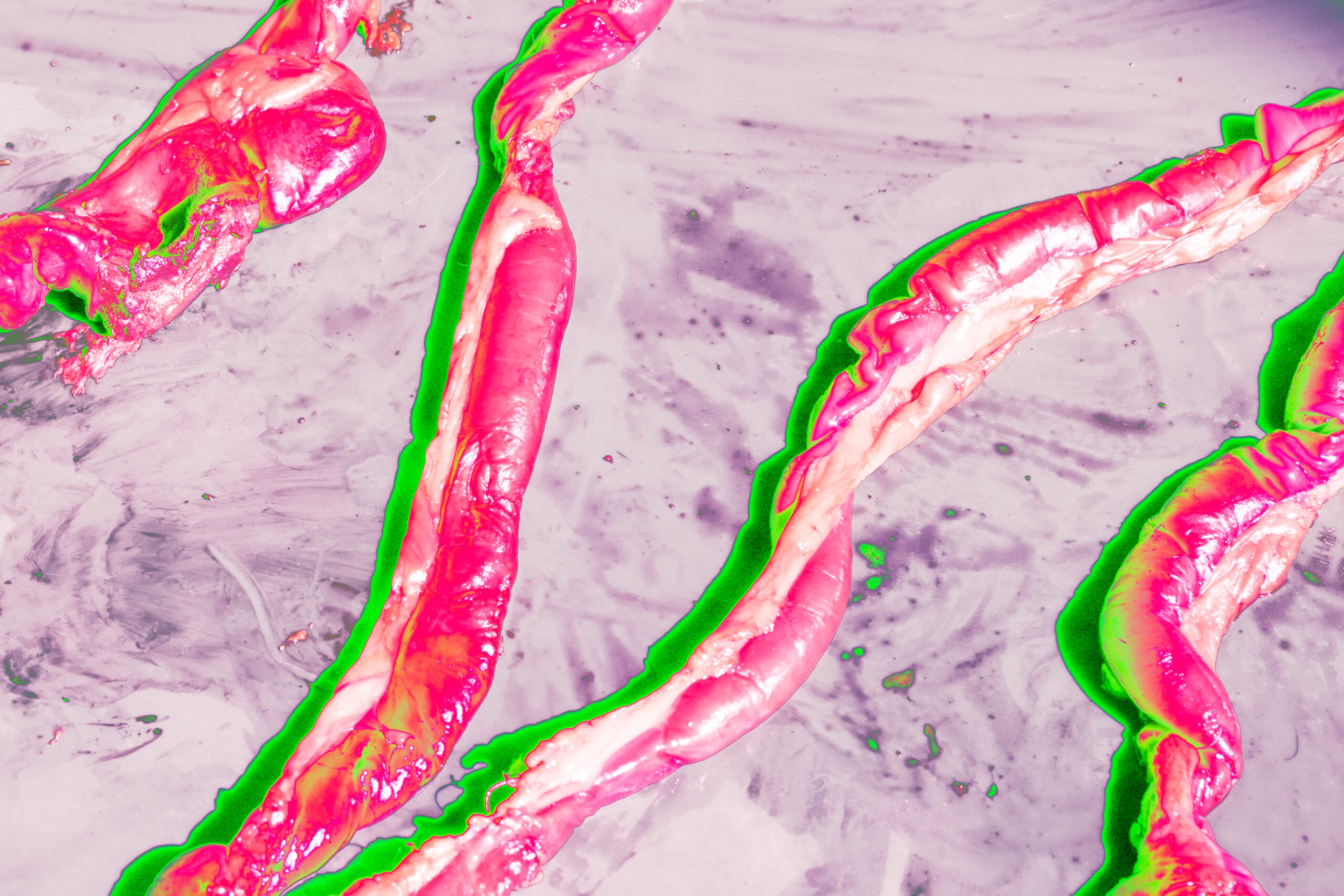
The grotesque appears frequently in my art – as a visual language that disrupts order, and as a way to confront the unspoken. I’m drawn to visual contradictions, where beauty turns unsettling. I prefer to construct everything in front of the camera myself. What you see is physically there.
I build surreal visions from raw materials, animal remains often appear in my work. I’m exploring the boundary between human and animal. The grotesque has deep roots here, in Central and Eastern Europe – shaped by our history, our politics, our absurdities.
It’s not just an aesthetic, but a way of seeing the world when it collapses and contradictions surface – that’s why I return to it, again and again.
I have always been close to science, it shaped the environment I grew up in – present in the way people around me explained the world, organized thought For a long time, I kept my distance. I chose art instead, instinctively, stubbornly. But as my practice developed, I realised I didn’t have to reject one to pursue the other. Art and science are not in conflict—they expand one another.
My recent work incorporates scientific tools – especially microscopes – not to replicate scientific inquiry, but to subvert it.
By bridging scientific and artistic methodologies, I aim to challenge dominant narratives – about the body and power, about antropocentrism and posthumanism, about the boundary between humans and animals. I find a potent ground for reimagining how we understand ourselves and the systems we create.